



Not every racing game is about smooth tarmac, polished circuits, and perfectly engineered race cars flying around manicured tracks.
Some racing experiences are built for something rawer, wilder, and far more dangerous — loose dirt beneath spinning wheels, steep hills that launch you into the air, and the kind of unpredictable terrain that punishes a single wrong move without warning or mercy.
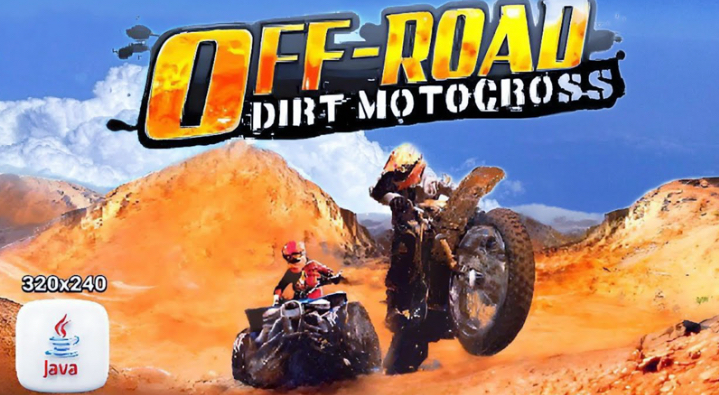
Xtreme Dirt Bike Java Game also known as Off-Road: Dirt Motocross was exactly that kind of game. It brought the muddy, thrilling, physically demanding world of off-road motocross racing to Java feature phones with genuine energy and surprising depth. No smooth roads. No safety barriers. Just you, a dirt bike, and some of the most challenging terrain a mobile racing game had ever produced on Java hardware.
For fans of motocross culture who grew up watching riders launch massive jumps, power slide through mud corners, and drag their knees through loose dirt berms, this game delivered that experience in the most accessible format imaginable — a feature phone, a keypad, and open dirt tracks stretching as far as the screen could show.
What Is Xtreme Dirt Bike Java Game?
Xtreme Dirt Bike Java Game is an off-road motocross racing title developed for Java-enabled feature phones.
The game places you on powerful dirt bikes across a series of outdoor off-road tracks featuring jumps, mud sections, steep inclines, tight corners, and rough terrain that behaves completely differently from conventional road racing surfaces.
Unlike tarmac racing games where the primary challenge is braking points and corner lines, Xtreme Dirt Bike challenges players with balance management, jump landing technique, throttle control on loose surfaces, and body position adjustments that make every track a physical puzzle as much as a speed competition.
The game featured multiple bikes with different performance characteristics, several challenging track environments, and a progression system that rewarded skill improvement with access to faster machines and more demanding courses.
Key Features
- Off-Road Track Environments — Multiple outdoor dirt track layouts featuring jumps, mud pits, hill climbs, steep descents, tight berms, and rough surface sections that demand different riding techniques from conventional road racing.
- Bike Roster with Performance Differences — Several dirt bikes available across performance tiers from entry-level machines suited to learning the game’s physics through to high-powered top-tier bikes demanding precise throttle and balance control.
- Jump & Landing System — A dedicated aerial mechanic covering launch angle, mid-air balance adjustment, and landing technique that determines whether a jump is completed smoothly or results in a crash.
- Terrain Physics — Different surface types including dry dirt, mud, gravel, and grass each affecting grip levels, acceleration response, and braking effectiveness in distinct ways that require adaptive riding approaches.
- Balance Management — A rider balance system requiring active input during challenging sections including steep climbs, technical descents, and mid-air phases to prevent the bike from tipping and crashing.
- Championship Mode — A structured competition format progressing through regional and national motocross events with points-based standings across multiple race rounds.
- Time Trial Mode — A solo practice format allowing track learning and personal best lap time improvement without competitive pressure.
- Bike Upgrade System — Performance improvement mechanics covering engine power, suspension setup, tyre grip, and braking efficiency allowing progressive bike development across career progression.
- Weather Conditions — Select tracks featured wet weather scenarios that altered surface grip, changed mud section behavior, and demanded more conservative throttle management than dry conditions permitted.
- Crash & Recovery — A realistic consequence system where significant riding errors resulted in crashes requiring recovery before race continuation, with crash frequency directly reflecting riding technique quality.
- Competitor AI — Rival riders with adaptive racing behavior that challenged players consistently without resorting to artificial performance advantages unfair to the player’s genuine skill development.
- Multiple Difficulty Settings — Adjustable challenge levels from beginner-friendly configurations to expert settings demanding genuine motocross technique mastery.
How to Play
Basic Controls
- 2 — Accelerate / Open throttle
- 8 — Brake / Close throttle
- 4 — Lean Left / Shift rider weight left
- 6 — Lean Right / Shift rider weight right
- 5 — Nitro boost where available
- 7 — Wheelie / Shift weight backward on flat sections
- 1 — Gear Down
- 3 — Gear Up
- 9 — Rear view / Check following riders
- 0 — Tuck in / Reduce air resistance on fast sections
- # — Pause race
- * — Toggle camera view
- OK button — Restart after crash / Confirm menu selections
Key Riding Techniques & Combinations
| Technique | Combination |
|---|---|
| Clean Jump Launch | Maintain full 2 throttle on jump approach + 6 to lean slightly back just before leaving the ramp |
| Mid-Air Balance | 4 or 6 during flight phase to adjust body position for correct landing angle |
| Smooth Landing | Level out with 4 or 6 in air + reduce throttle with light 8 before rear wheel contacts ground |
| Double Jump Carry | Full 2 throttle through first jump landing + immediately lean back with 6 for second jump launch |
| Mud Section Technique | Reduce to half throttle through mud + 6 lean right or 4 lean left to maintain balance through resistance |
| Hill Climb | Full 2 throttle + 6 to shift weight back preventing front wheel lift on steep inclines |
| Steep Descent | Reduce throttle to minimum + 4 lean forward to keep front wheel grounded on downhill sections |
| Loose Corner | Brake early with 8 before corner entry + lean with 4 or 6 through apex + progressive 2 on exit |
| Berm Corner | Maintain momentum with 2 + lean into berm with 4 or 6 allowing banked surface to guide turn |
| Wheelie Control | 7 on flat section + maintain 2 throttle + 4 forward lean to prevent complete backward flip |
| Drift Slide | Trail 8 braking into loose corner + 4 or 6 lean to initiate controlled rear wheel slide |
| Rhythm Section Flow | Maintain consistent 2 throttle across multiple small jumps + 6 lean back each takeoff for smooth flow |
The Terrain
This is where Xtreme Dirt Bike separates itself from conventional racing games. Each surface type behaves differently and demands a different approach:
Dry Dirt — The most predictable surface in the game. Grip is good, braking is reliable, and acceleration responds consistently. This is your baseline — master dry dirt technique first before tackling more challenging surfaces.
Mud — Significantly reduces grip on both acceleration and braking. Throttle inputs must be gentler to avoid wheel spin, braking distances increase, and corners require earlier entry and slower speeds than dry conditions allow. Never apply full throttle suddenly in mud sections — build speed gradually.
Gravel — Unpredictable and loose. Corners on gravel require the widest possible entry lines and the most conservative speeds in the game. Braking on gravel demands gradual progressive input rather than hard sudden application that causes immediate front wheel lockup and crashes.
Grass — Slippery under braking but relatively predictable under acceleration. Approach grass sections with moderate speed and avoid aggressive braking maneuvers that the surface cannot support without losing traction.
Wet Conditions — Every surface becomes significantly more challenging in wet weather. Reduce all inputs by approximately thirty percent compared to dry equivalents — smoother, gentler, and more progressive across throttle, braking, and lean angle simultaneously.
Jump Guide
Jumps are where races are won or lost in Xtreme Dirt Bike. A perfect jump gains time. A poor jump causes crashes that cost positions no recovery can fully repair. Here is exactly what to do:
Before the Jump — Approach at consistent speed. Do not brake suddenly on the approach ramp. Maintain steady throttle and shift weight slightly back using 6 just before the launch point.
In the Air — Use 4 and 6 actively to control your landing angle. You want the bike roughly level or very slightly nose-up when the wheels make contact. A nose-down landing at speed almost always causes a crash.
Landing — Reduce throttle slightly just before rear wheel contact. Absorb the landing with progressive throttle re-application — do not slam full power the instant you touch down as this causes rear wheel spin and loss of control on exit.
Double Jumps — The transition between consecutive jumps requires full throttle through the landing of the first jump to generate enough speed for the second launch. Never brake between double jumps — momentum is everything.
Bike Selection Guide
Entry Level Bikes — Lower power output but forgiving handling that tolerates mistakes without severe consequence. Learn the jump system, terrain differences, and corner technique on these bikes before moving up. Their slower speed gives more time to react to changing track conditions.
Mid Tier Bikes — Significantly more power with manageable handling. The sweet spot for most of the game’s championship progression. Fast enough to compete at the front of any grid while forgiving enough to recover from minor errors.
Top Tier Bikes — Maximum power and speed but zero tolerance for poor technique. Every input must be precise and every jump approach must be measured. These bikes reward the skills learned on lower-tier machines and punish any laziness immediately and without warning.
Championship Tips
Study each track in time trial mode before entering championship races.
Understanding where every jump is, where the mud sections begin and end, and where the tight corners demand early braking makes the first championship lap a confident performance rather than a reactive improvisation.
Secure strong qualifying positions before races because passing on dirt tracks is significantly more difficult than on road circuits — overtaking opportunities are limited to specific wide sections and jump landing zones where competitors are briefly vulnerable.
Manage your bike’s condition across a championship round — unnecessary crashes accumulate damage that reduces performance in later races when points matter most.
Game | Jar
Why It Still Matters
Xtreme Dirt Bike Java Game delivered something genuinely uncommon on Java hardware — an off-road racing experience with enough mechanical depth to reward serious engagement rather than casual play.
It respected the genuine difficulty of motocross riding, translated those demands into accessible keypad mechanics, and built a racing experience that felt physically honest in a way that smooth road racing titles never quite achieved.
For fans of motocross culture in regions where the sport existed on television screens and YouTube videos rather than local circuits and race days, this game was their closest connection to the dirt — the jumps, the mud, the balance, and the raw physical challenge of riding fast across terrain that never cooperated.
It was simple to understand, genuinely challenging to master, and completely honest about the skill it demanded. That combination — accessibility without compromise — is what made it worth playing then and worth remembering now.
“Smooth roads are for smooth riders. The dirt was always for everyone else — and this game knew exactly which one was more fun.”
—————————————————————————
This content is published for review and educational purposes only.
All trademarks, game titles, and related assets belong to their respective owners. We do not host any download files and the links are for respective users.
