


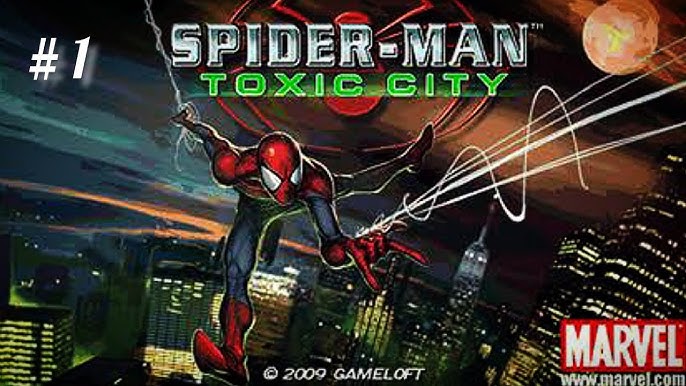

There has always been something magnetic about Spider-Man — the idea that an ordinary person could swing between skyscrapers, defy gravity, and face down villains twice their size armed with nothing but wit, webs, and sheer determination. Now imagine all of that compressed into the palm of your hand, running on a Java phone with buttons worn smooth from use. That was Spider-Man: Toxic City Java Game — and it was nothing short of spectacular for its time. While console gamers were swinging through New York on PlayStation and Xbox, millions of mobile players were doing the same thing on tiny screens, and loving every second of it just as much. Gameloft took Marvel’s most beloved hero, dropped him into a poisoned, crumbling New York City, and built an action experience that felt urgent, cinematic, and genuinely thrilling. This was not a cheap cash-grab tie-in. This was a proper Spider-Man game that just happened to live in your pocket.
What Is Spider-Man: Toxic City Java Game?
Spider-Man: Toxic City Java Game is an action-platformer developed by Gameloft for Java-enabled feature phones, released around 2010–2011. The game presents an original storyline separate from any specific film or comic arc — New York City has been overrun by a toxic chemical threat, mutating ordinary criminals into dangerous supervillains and turning the streets into a war zone. Spider-Man must swing, crawl, fight, and web-sling his way through a series of increasingly dangerous missions to uncover the source of the toxin and save the city before it is too late. The game blended side-scrolling combat, wall-crawling platforming, and boss battles into a surprisingly cohesive experience that captured the feel of being Spider-Man better than most mobile games of its generation had any right to.
Key Features
Spider-Man: Toxic City Java Game delivered a feature set that genuinely impressed for its platform. The game offered multiple story-driven missions spread across a poisoned New York, each with distinct environments ranging from street-level brawls to rooftop chases and underground facility infiltrations. Spider-Man’s signature abilities were all present — web-slinging for movement, wall and ceiling crawling, web-shooting for combat, and acrobatic melee combos against groups of enemies. A variety of mutated villains appeared across the campaign, each requiring different tactics to defeat. Power-ups and health pickups were scattered throughout levels, and the game rewarded exploration with hidden bonuses. The visual style was bold and comic-book inspired, with sharp character sprites, detailed backgrounds, and smooth animation that brought the action to life on even the most modest Java-capable screen.
How to Play
Basic Controls
The control scheme is built around the standard numeric keypad and is designed to keep the action flowing without interruption:
- 4 / 6 — Move Left / Move Right
- 2 — Jump / Leap upward
- 8 — Crouch / Duck under attacks
- 5 — Punch / Basic melee attack
- 0 — Web Shot / Fire web at enemy or surface
- 7 — Wall Crawl activation / Stick to surfaces
- 1 — Web Swing / Launch swing across gaps
- 3 — Kick / Heavy strike
- 9 — Special Attack / Web Burst (uses web energy)
- # — Block / Defensive stance
- * — Pause / Menu access
- OK button — Interact / Context action (pick up items, open doors)
Combat Combinations & Attack Moves
| Move | Combination |
|---|---|
| Basic Combo | 5, 5, 5 — three-hit punch sequence |
| Combo Finisher | 5, 5, 3 — two punches into a heavy kick knockdown |
| Web Snare | 0 to shoot web + enemy is temporarily immobilized |
| Web Yank | 0 while facing enemy + 6 to pull them toward you |
| Aerial Attack | 2 to jump + 5 mid-air for a diving punch |
| Aerial Web Strike | 2 to jump + 0 to fire web downward onto enemy below |
| Wall Launch Attack | 7 to stick to wall + 2 to leap off + 5 to strike mid-air |
| Web Burst | 9 to release area web explosion — clears surrounding enemies |
| Ceiling Drop Attack | 7 to crawl ceiling above enemy + 2 to drop + 3 for heavy slam |
| Swing Kick | 1 to swing + 3 at peak of swing arc for flying kick |
| Counter Block | # just before enemy strike connects — staggers attacker |
| Ground Pound | Hold 2 briefly to climb height + 8 + 3 simultaneously to slam down |
Movement & Traversal Tips
Wall crawling is not just for show — use it constantly to gain positional advantage over enemies who cannot follow you onto vertical surfaces. Web swinging across larger gaps requires momentum, so always launch the swing while already moving in the desired direction rather than standing still. On rooftop levels, staying elevated gives you aerial attack opportunities that ground-based enemies struggle to defend against. When surrounded by multiple enemies, the Web Burst special move is your best friend — it clears space instantly and gives you a second to reposition. Save your web energy for boss encounters where crowd control matters most rather than spending it freely on regular enemies in early levels.
Boss Battle Strategy
Each major villain in Spider-Man: Toxic City Java Game has a specific weakness and a pattern that must be recognized before it can be exploited:
Mutated Brute Enemies — These heavily armored opponents cannot be staggered by basic punches. Use web snare first to immobilize them, then follow up with the combo finisher before their resistance recovers. Repeat the cycle patiently rather than trading blows directly.
Mid-Level Bosses — These enemies alternate between aggressive rushes and brief recovery pauses. The pause is your attack window. Stay mobile, dodge with directional movement during their rush phase, and unleash your full combo sequence only during the recovery pause.
Final Boss Encounters — These require all your accumulated skills simultaneously. Maintain web energy reserves, use the ceiling and walls to avoid ground-based attacks, and prioritize survival over aggression. A patient, methodical approach defeats final bosses far more reliably than reckless offense.
Why It Still Matters
Spider-Man: Toxic City Java Game was proof of something important — that superhero gaming was never exclusively the domain of high-powered consoles and expensive hardware. For a generation of young players in developing markets who experienced Marvel not through cinemas or consoles but through a feature phone screen, this game was their gateway into Spider-Man’s world. It sparked imaginations, inspired fan loyalty, and delivered genuine excitement through nothing more than a few hundred kilobytes and a well-designed keypad control scheme. Today it endures through emulator communities and nostalgic retrospectives, remembered not as a lesser version of a console game but as a great game on its own terms — one that swung as high as its technology allowed and never looked down.
“With great power comes great responsibility — and with a great Java game comes greatness that never needed a console to prove itself.”
—————————————————————————
This content is published for review and educational purposes only.
All trademarks, game titles, and related assets belong to their respective owners. We do not host any download files and the links are for respective users.
