


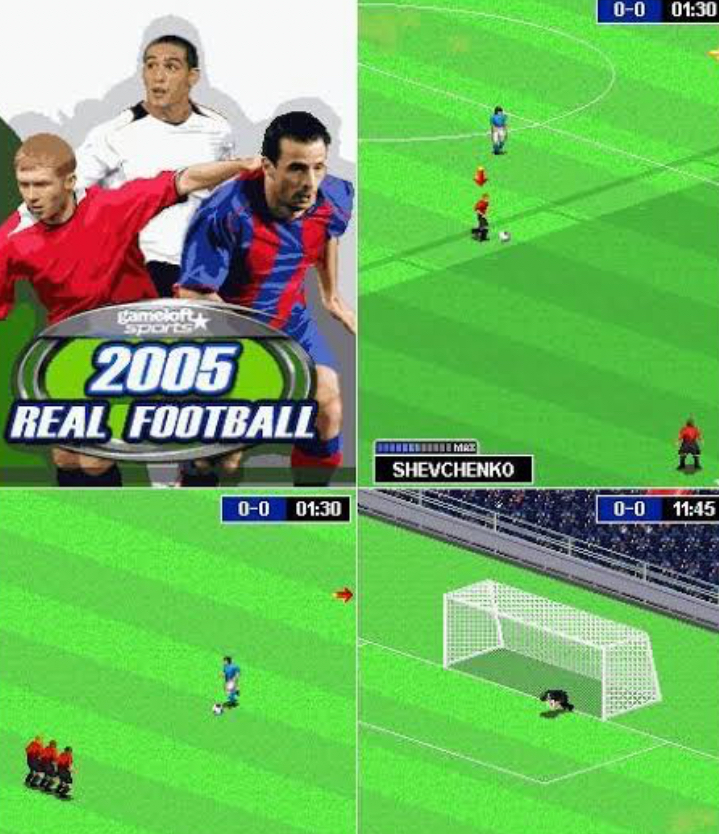

Before the polished graphics, before the deep career modes, before the Bluetooth multiplayer and the atmospheric stadium environments that would define later entries in the series — there was the beginning.
There was Real Football 2005 Java Game. And what a beginning it was. Released by Gameloft at a time when mobile gaming was still finding its feet and the very idea of a fully playable football simulation on a feature phone felt more like ambition than reality, Real Football 2005 arrived and immediately rewrote every expectation anyone had ever held about what Java hardware could deliver.
It was raw. It was bold. It was, by every honest measure, years ahead of where mobile football had any right to be in 2005. While the world was watching Ronaldinho dazzle at the Camp Nou, Thierry Henry dismantle Premier League defenses with terrifying elegance, and a young Lionel Messi beginning his quiet ascent toward immortality, a small but perfectly formed football universe was quietly running on Nokia and Sony Ericsson phones across every continent — demanding the same tactical intelligence, the same competitive fire, and delivering the same gut-punch of a last-minute winner that the real sport had always promised.
Real Football 2005 was not just the first chapter of one of mobile gaming’s greatest franchises. It was proof, delivered without hesitation, that the beautiful game belonged everywhere — including the palm of your hand.
What Is Real Football 2005 Java Game?
Real Football 2005 Java Game is a football simulation title developed by Gameloft for Java-enabled feature phones, representing the debut entry in what would become one of the most celebrated and long-running mobile football franchises in gaming history.
Released in 2004–2005, the game established the foundational identity of the Real Football series — direct control of players during live match action rather than pure simulation, a selection of international clubs and national teams, and a career progression structure that rewarded sustained investment and tactical development over multiple seasons.
While the 2005 edition naturally lacked the depth and visual refinement of later entries, it compensated with a focused, clean, and genuinely enjoyable football experience that demonstrated Gameloft’s understanding of what mobile players needed from the sport — immediacy, responsiveness, and the authentic emotional rhythm of a competitive football match compressed into a format playable anywhere, at any time, on any Java-capable device.
Key Features
- Club & International Team Selection — A carefully assembled roster of clubs drawn from Europe’s top leagues alongside national teams representing major footballing nations, providing immediate competitive variety from the game’s opening moments.
- Live Match Control — Direct real-time control of players during match action rather than simulation-only mechanics, putting tactical and technical decisions entirely in the hands of the player for every moment of every match.
- Career Mode — A multi-season management and playing structure allowing progression through league competitions, cup tournaments, and promotional challenges across an extended football career spanning multiple in-game years.
- Transfer System — A functional player acquisition and release mechanic enabling squad building and strengthening across transfer windows, with budget constraints creating meaningful financial decisions throughout career progression.
- Formation Selection — Pre-match tactical setup covering the era’s most widely used formations including 4-4-2, 4-3-3, 3-5-2, and 5-3-2, each offering distinct defensive and attacking structural advantages depending on opposition and match context.
- Player Attributes — Individual player ratings covering speed, shooting accuracy, passing quality, defensive capability, and physical strength, creating meaningful performance differences between squad members that directly influenced match outcomes.
- League & Cup Competitions — Structured competitive formats including domestic league campaigns with full standings, points tables, and goal difference tracking alongside knockout cup competitions offering parallel championship objectives throughout each season.
- Training System — A between-match player development mechanic allowing targeted improvement of individual player attributes across key performance areas, providing a progression layer above simple match-to-match competition.
- Opposing Team AI — Competitive artificial intelligence that adapted basic tactical behavior to match context, pressing aggressively when chasing goals and defending compactly when protecting leads, providing a responsive and reasonably unpredictable opponent across all difficulty levels.
- Match Statistics — Post-match performance data covering shots on target, possession percentage, corners, fouls, and individual player ratings, providing analytical feedback for tactical adjustment between fixtures.
- Home & Away Dynamics — A match context system acknowledging the competitive difference between home and away fixtures through crowd atmosphere variation and subtle performance adjustments reflecting the genuine advantage of familiar surroundings.
- Penalty Shootout System — A dedicated penalty shootout mechanic for cup knockout matches decided level after full time, requiring precise directional input and goalkeeper reaction timing to determine progression in the most pressurized format football offers.
- Multiple Difficulty Levels — Adjustable AI competition intensity spanning accessible entry settings for new players through to demanding expert configurations requiring genuine tactical discipline and technical proficiency to overcome consistently.
- Save & Continue System — A progress preservation mechanic allowing career mode advancement to be saved between sessions, enabling long-term franchise building across multiple play periods without losing accumulated progress.
How to Play
Basic Controls
Real Football 2005 Java Game established the keypad control blueprint that the entire series would build upon across subsequent editions — logical, responsive, and learnable within a single match:
- 2 / 4 / 6 / 8 — Move player in all four cardinal directions
- 5 — Pass / Short pass to nearest available teammate
- 0 — Shoot / Strike at goal when in attacking positions
- 7 — Sprint / Speed burst activation
- 1 — Switch player / Select nearest defender when defending
- 3 — Tackle / Challenge for ball possession
- 9 — Cross / Lob ball into penalty area from wide positions
- # — Through ball / Play pass into space behind defensive line
- * — Goalkeeper instruction / Claim high ball into box
- OK button — Skill move / Change of direction dribble
Attacking Combinations & Offensive Moves
| Move | Combination |
|---|---|
| Power Shot | Hold 0 for 2 seconds before releasing for maximum strike power |
| Placed Shot | 0 + directional key toward chosen corner for accuracy over power |
| Chip Shot | 8 + 0 simultaneously when one-on-one with advancing goalkeeper |
| Through Ball Run | # to play ball into space + 7 to sprint onto pass |
| Wing Cross & Header | 9 near byline + position striker centrally + 8 + 0 to attack cross |
| One-Two Combination | 5 to pass + # immediately to run + 5 again to receive return ball |
| Sprint Dribble | Hold 7 continuously + directional keys to carry ball at pace |
| Cutback Pass | Carry ball to byline with 7 + 5 back across goal to arriving midfielder |
| Long Range Drive | Retreat to edge of penalty area + hold 0 at full power for long shot |
| Dummy Run | OK button near defender to feint direction + accelerate opposite way with 7 |
Defensive Combinations & Defensive Play
| Move | Combination |
|---|---|
| Sliding Tackle | 3 when within range of ball carrier for ground challenge |
| Standing Challenge | 1 to select nearest defender + 3 lightly for upright shoulder challenge |
| Tracking Run | 1 repeatedly to cycle defenders + 7 to match opponent’s sprint pace |
| Defensive Header | Position defender in crossing lane + 8 + 3 to attack aerial ball |
| Goalkeeper Rush | * when attacker breaks clear to command keeper off line |
| Offside Trap | Push entire defensive line forward simultaneously using 2 as opponent receives pass |
| Block Shot | Position outfield player directly in shooting lane + hold 3 to set stance |
Tactical Tips & Winning Strategy
The formation decision made before kick-off carries more weight in Real Football 2005 than in any subsequent series entry — the game’s relatively streamlined mechanics mean structural setup determines the shape of every attacking and defensive situation that follows. Against technically superior opposition a 5-3-2 provides defensive solidity at the cost of attacking width, forcing the opposition to break down a compact central block rather than exploiting open flanks.
Against weaker opponents a 4-3-3 provides attacking overloads in wide areas that mid-table AI defenses consistently struggle to handle across a full ninety minutes.
Invest training resources into your two central midfielders before any other position — in Real Football 2005’s match engine central midfield dominance translates directly into possession control that limits the opposition’s attacking opportunities while consistently supplying your forward line with quality ball.
In career mode resist the temptation to sign expensive established players in the first transfer window — younger players with moderate current ratings but high development potential will outperform costly veterans within two seasons of consistent training investment and deliver significantly greater long-term squad value within the budget constraints the game imposes.
Get game 240×320 | JAR
Why It Still Matters
Real Football 2005 Java Game matters because it was the promise — the original statement of intent from which an entire franchise, an entire generation of mobile football gaming, and an entire culture of feature phone sports competition grew.
It was not the most technically accomplished entry in the Real Football series. It was not the deepest or the most visually impressive. But it was the first. And in being the first it carried a weight and a significance that no subsequent entry, however polished, could ever fully replicate.
It arrived at a moment when mobile gaming needed proof that serious sports simulation was possible on modest hardware and it provided that proof comprehensively, confidently, and without compromise.
For the players who discovered it in 2005 — many of whom had never owned a console, never visited an arcade, and never played a football game on anything more powerful than the device sitting in their shirt pocket — it was not the beginning of a franchise. It was the beginning of everything.
And everything, as it turned out, was built on a foundation that this quiet, brilliant, pioneering little game laid down with extraordinary care.
“Every dynasty begins somewhere. Every great series has a first chapter. And sometimes, the first chapter is the one that mattered most of all.”
—————————————————————————
This content is published for review and educational purposes only.
All trademarks, game titles, and related assets belong to their respective owners. We do not host any download files and the links are for respective users.
