



Every four years, the world stops for one thing — the FIFA World Cup.
In 2014, Brazil hosted the tournament and the whole world watched. FIFA 2014 Java Game brought that same World Cup energy directly to feature phones.
While fans across the globe followed the tournament on television, millions of others were living their own version of it on Java phones — picking their nation, building through the group stage, and chasing the ultimate prize. It was simple, it was fun, and it captured everything that made the World Cup special. No console needed. No big screen required. Just football, a keypad, and the dream of lifting the trophy.
What Is FIFA 2014 Java Game?
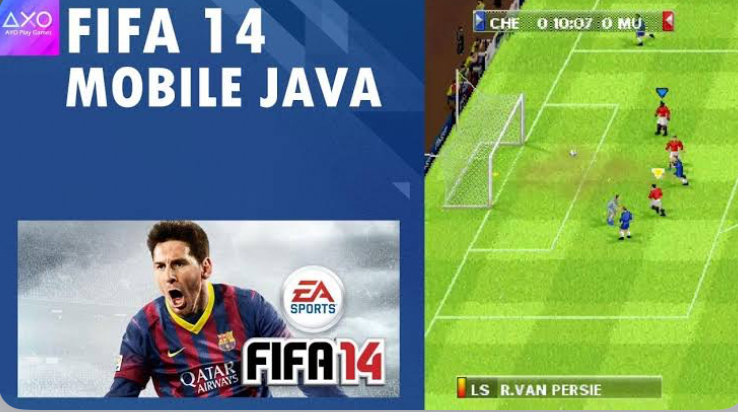
FIFA 2014 Java Game is a football simulation title developed for Java-enabled feature phones, released in conjunction with the 2014 FIFA World Cup held in Brazil.
Built on the established Real Football and FIFA mobile gaming foundations that Gameloft and EA’s mobile divisions had refined across multiple preceding titles, FIFA 2014 Java Game represented a significant technical and content achievement for its platform — delivering the full World Cup experience across an authentic international team roster, genuine tournament structures, updated player squads reflecting the actual 2014 World Cup qualifying nations, and a match engine refined to its most responsive and visually accomplished state on Java hardware.
The game placed players in control of their chosen national team through the full arc of World Cup competition — group stage qualification battles, knockout round tension, and the ultimate prize of the World Cup final played under the Brazilian sun at the Maracanã.
It was the complete World Cup fantasy delivered to the most accessible gaming platform on earth, and it executed that fantasy with the confidence and quality the occasion deserved.
Key Features
- Official 2014 FIFA World Cup Licensing — Full tournament authentication covering all 32 qualified national teams, accurate squad rosters reflecting the actual 2014 World Cup competition, and tournament branding faithful to the Brazil 2014 identity that made the game feel genuinely connected to the real event rather than a generic football simulation wearing tournament clothing.
- Complete 32-Team World Cup Roster — All 32 nations that qualified for the 2014 FIFA World Cup in Brazil represented with authentic squad compositions, including powerhouses such as Brazil, Germany, Argentina, Spain, France, and the Netherlands alongside qualification stories from nations making rare or debut World Cup appearances.
- Star Player Representations — Key players from each national squad rendered with performance attributes reflecting their real-world quality and playing style, covering global superstars including Lionel Messi, Cristiano Ronaldo, Neymar, Thomas Müller, Luis Suárez, Robin van Persie, Karim Benzema, and dozens of other World Cup participants whose individual quality shaped the tournament’s narrative.
- Full World Cup Tournament Mode — A complete Group Stage through Final tournament structure mirroring the actual 2014 World Cup format — six groups of four teams, group stage fixtures, points-based qualification for the Round of 16, knockout bracket progression through quarter-finals, semi-finals, and the World Cup Final, with authentic match scheduling logic reflecting the real tournament’s structural organization.
- World Cup Stadium Environments — Match environments drawing from the 2014 World Cup’s Brazilian host venues, including atmospheric representations of iconic stadiums such as the Maracanã, the Estádio do Mineirão, the Arena Corinthians, and the Estádio Castelão, each rendered with enough visual distinction to evoke the specific atmosphere of Brazil’s World Cup host cities.
- Live Match Control Engine — Direct real-time player control during match action delivering the most responsive and fluid match experience the Java platform could produce, with player movement, passing accuracy, shooting mechanics, and defensive engagement all refined beyond the standards established by preceding titles in the mobile football lineage.
- Refined Shooting Mechanics — An enhanced goal-scoring system offering greater directional precision, power calibration depth, and shot variety than earlier Java football titles, covering driven finishes, placed shots, chip attempts, headers from crosses, long-range efforts, and penalty kicks each with distinct input requirements and outcome probability profiles.
- Tactical Formation System — A comprehensive pre-match tactical setup covering all major international formation preferences used by the 2014 World Cup’s competing nations, from Germany’s fluid 4-3-3 to Italy’s defensive 4-2-3-1 and Brazil’s attack-oriented 4-2-4, allowing tactical authenticity in national team selection decisions.
- Player Morale & Form System — A performance variable mechanic reflecting the psychological dimension of tournament football — players in good form produced elevated performance output while those carrying poor form or morale penalties underperformed their base attribute ratings, adding a management layer to squad selection decisions between tournament matches.
- Penalty Shootout System — A dedicated and refined penalty mechanics system for knockout matches decided level after extra time, covering both the shooter’s directional and power selection and the goalkeeper’s anticipation and dive decision, delivering the full emotional weight of World Cup penalty drama in mobile format.
- Quick Match & Friendly Mode — An accessible standalone match format allowing any two of the 32 World Cup nations to compete in immediate friendly fixtures outside tournament structure, providing flexible play options for sessions too short for full tournament commitment.
- Difficulty Calibration System — Multiple competition intensity settings spanning introductory levels suited to players new to mobile football through expert configurations demanding the technical and tactical discipline appropriate for representing national teams at the World Cup’s highest competitive tier.
- Match Commentary & Atmosphere — Audio design elements drawing from the World Cup’s distinctive sonic identity including crowd atmosphere variations, goal celebration audio, and match event sound design that elevated the emotional engagement of key match moments beyond what visual presentation alone could deliver.
- Player Development Between Matches — A form and confidence progression mechanic rewarding consistent performance with incremental player attribute improvements across the tournament, reflecting the real-world phenomenon of players growing into tournament competition as confidence and momentum accumulated through successful results.
- Comprehensive Match Statistics — Post-match performance data covering possession percentage, shots on and off target, corners, fouls, passing accuracy, individual player ratings, and tournament statistics accumulation, providing the analytical depth appropriate for a competition as statistically documented as the FIFA World Cup.
How to Play
Basic Controls
FIFA 2014 Java Game refines the mobile football control blueprint established across preceding titles into its most polished and responsive expression on Java hardware:
- 2 / 4 / 6 / 8 — Move player in all four directions with diagonal movement via combinations
- 5 — Pass / Short pass to nearest available teammate
- 0 — Shoot / Strike at goal from any attacking position
- 7 — Sprint / Acceleration burst
- 1 — Switch player / Select nearest defensive option
- 3 — Tackle / Physical challenge for ball possession
- 9 — Cross / Deliver ball into penalty area from wide positions
- # — Through ball / Penetrating pass into space behind defensive line
- * — Goalkeeper command / High ball claim instruction
- OK button — Skill move / Directional dribble change
Attacking Combinations & Offensive Moves
| Move | Combination |
|---|---|
| Power Drive Shot | Hold 0 for 2 seconds before releasing for maximum power finish |
| Placed Corner Finish | 0 + directional key toward chosen goalpost for precision over power |
| Chip Over Goalkeeper | 8 + 0 simultaneously when goalkeeper advances off line |
| World Cup Header | 9 from wide position + position striker centrally + 8 + 0 to attack delivery |
| Through Ball Penetration | # to play into space behind defensive line + 7 to sprint onto pass |
| One-Two Wall Pass | 5 to pass + # immediately to run forward + 5 again for return ball |
| Wing Overload | 7 sprint down flank + 9 at byline for low driven cutback cross |
| Long Range World Cup Strike | Withdraw to edge of penalty area + hold 0 at full power for speculative effort |
| Penalty Area Combination | 5 short pass inside box + immediate 0 first-time finish before defensive recovery |
| Dummy & Drive | OK button near defender for directional feint + 7 to accelerate into created space |
| Volley Finish | Position for incoming cross + 2 + 0 simultaneously to attempt volley |
| Counter Attack Launch | 1 to win possession + # immediately for direct penetrating pass + 7 sprint |
Defensive Combinations & Defensive Play
| Move | Combination |
|---|---|
| Sliding Block | 3 at precise moment of opponent’s strike attempt to deflect shot |
| Tracking Sprint | 1 to select nearest defender + 7 to match opponent’s acceleration |
| Aerial Defensive Claim | Position centrally in crossing lane + 8 + 3 to challenge for aerial ball |
| Offside Trap Execution | Push defensive line forward simultaneously using 2 as opponent prepares to receive |
| Goalkeeper Positioning | * to command keeper off line against advancing attacker |
| Midfield Pressing Trap | 1 to select pressing midfielder + 3 to engage ball carrier immediately after loss |
| Defensive Header Clear | Position highest-rated header defender in aerial zone + 8 + 0 to clear decisively |
Penalty Shootout Guide
The World Cup penalty shootout is the most psychologically intense moment football offers — and FIFA 2014 Java Game reproduces that intensity faithfully. As shooter, select your direction using 4 or 6 combined with 0, calibrating power with hold duration before releasing.
Vary your direction selection unpredictably rather than establishing a pattern the goalkeeper AI can read across successive kicks. As goalkeeper, observe the shooter’s movement initiation before committing to a dive direction — early commitment to an incorrect side leaves the opposite corner completely exposed.
Save your highest-confidence penalty taker for the fifth kick if the shootout reaches that point — the psychological weight of a deciding kick demands your most composed and technically assured player.
Tournament Strategy & Team Selection
Choosing your national team for World Cup campaign mode is the single most consequential decision the game presents — it determines squad depth, individual player quality, tactical flexibility, and the realistic ambition of tournament progression simultaneously.
Brazil and Germany offer the most complete squads with quality distributed across all positions and tactical systems capable of dominating any opposition.
Argentina provides Messi’s individual brilliance as a decisive X-factor but demands careful defensive organization to compensate for relative vulnerability at the back.
Spain’s tiki-taka passing identity translates directly into the game’s passing mechanics, making them the most technically rewarding team for possession-oriented players.
For a genuine challenge, selecting a lower-ranked qualification nation — Algeria, Costa Rica, or Greece — transforms the tournament into a tactical survival exercise requiring maximum defensive discipline and ruthless exploitation of limited attacking opportunities.
Formation selection must reflect squad personnel rather than personal preference — playing Germany’s system with Costa Rica’s squad produces worse results than adapting tactical setup to available player quality. Review your squad’s strongest positions before confirming formation choice and build your system around genuine personnel strengths rather than theoretical tactical ideals.
Group Stage Management
The group stage is where World Cup campaigns are shaped before the knockout rounds deliver their irreversible consequences. Three points from the opening fixture establishes psychological momentum and qualification breathing room that fundamentally changes the approach available in subsequent group games.
Identify your group’s weakest nation and target maximum points from that fixture — dropped points against lower-ranked opposition are the most common cause of group stage elimination for stronger nations managing conservative approaches incorrectly.
Goal difference matters in tight groups where multiple teams finish level on points — winning comfortably when the opportunity presents itself is always preferable to protecting a narrow lead unnecessarily when a second goal is readily available.
Get game | Jar
Why It Still Matters
FIFA 2014 Java Game gave millions of fans their own personal World Cup at a time when the real tournament felt out of reach. No ticket, no television subscription, no console — just a Java phone and the same football dream everyone else was chasing. It was straightforward, honest, and genuinely enjoyable. For the generation that played it, it was not a lesser version of anything. It was simply football — clean, direct, and completely theirs.
“Thirty-two nations. One trophy. Billions of dreams. And somehow, impossibly, all of it fitting in the palm of your hand — because football was never about the size of the screen. It was always about the size of the moment.”
—————————————————————————
This content is published for review and educational purposes only.
All trademarks, game titles, and related assets belong to their respective owners. We do not host any download files and the links are for respective users.
