


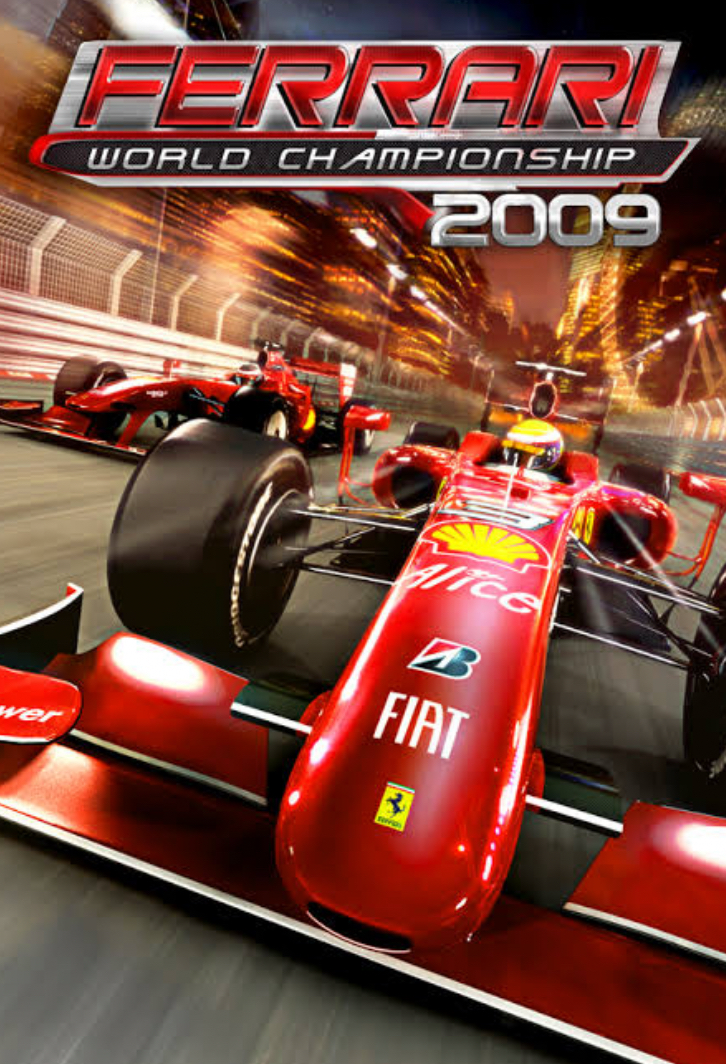

There is one name in motorsport that carries more history, more passion, and more emotional weight than any other. Not a team. Not a constructor. A legend. Ferrari.
Since 1950, the Scuderia has represented everything motorsport stands for at its most romantic and most ruthless scarlet red machines, screaming engines, championship glory, heartbreaking defeats, and a relationship with its fans so intense and so personal that no other sporting institution on earth quite replicates it.
Ferrari World Championship 2009 Java Game commonly known as FWC placed that entire legacy directly into the hands of feature phone users worldwide at a moment when Formula One itself was producing some of its most dramatic and fiercely contested racing in years.
Kimi Räikkönen and Felipe Massa carrying the Ferrari hopes. Lewis Hamilton and the McLaren brigade providing relentless opposition.
The Brawn GP story unfolding as the most remarkable underdog narrative the sport had seen in decades.
All of it happening simultaneously while a Java game sat on millions of feature phones offering every Ferrari fan on the planet the chance to do what Räikkönen and Massa could not quite manage that season — bring the championship home to Maranello. No simulator rig required. No expensive gaming setup needed. Just a feature phone, a numeric keypad, and the most famous racing car in the world waiting for your instructions.
What Is Ferrari World Championship 2009 Java Game?
Ferrari World Championship 2009 Java Game is an officially licensed Formula One racing simulation developed for Java-enabled feature phones, built exclusively around the Ferrari brand and the 2009 Formula One World Championship season.
Unlike general Formula One mobile titles that covered the full grid of competing constructors, FWC focused its entire identity on Ferrari — the cars, the drivers, the team history, and the championship challenge from the specific perspective of the Scuderia rather than the broader competitive field.
The game delivered a three-dimensional racing experience placing players behind the wheel of the Ferrari F60 — the actual car Ferrari designed and raced throughout the 2009 season — across authentic Formula One circuits drawn from the real 2009 championship calendar.
Championship mode tasked players with achieving what the real Ferrari team ultimately failed to deliver that year — championship glory against Jenson Button’s dominant Brawn GP and the rest of the field. The Ferrari focus gave the game a specific emotional identity that general F1 titles lacked — this was not simply motorsport simulation.
This was Ferrari. And Ferrari, as every fan of the Scuderia understands completely, is never simply anything.
Key Features
- Official Ferrari Licensing — Full Scuderia Ferrari authentication covering the Ferrari F60 car, team livery, driver representations, and brand identity faithful to the 2009 season’s visual and competitive reality.
- Ferrari F60 — The Real 2009 Car — The actual Ferrari chassis raced throughout the 2009 Formula One season rendered in three-dimensional detail, with performance characteristics reflecting the car’s real-world strengths and the technical challenges it faced against that season’s dominant Brawn GP machinery.
- Kimi Räikkönen & Felipe Massa — Both Ferrari drivers from the 2009 season available as playable options, each with distinct driving style attribute profiles reflecting their real competitive identities — Räikkönen’s ice-cold technical precision and Massa’s aggressive attacking approach.
- 2009 Formula One Circuit Roster — Authentic tracks from the real 2009 F1 calendar rendered in three-dimensional format including iconic venues such as Monaco, Monza, Silverstone, Spa-Francorchamps, Suzuka, and the Nürburgring, each preserving genuine layout characteristics and technical demands.
- 3D Racing Perspective — A genuine three-dimensional behind-the-car camera delivering the sensation of Formula One speed, corner entry angles, and spatial awareness across each circuit’s varied layout characteristics.
- Full Championship Season Structure — A complete 2009 Formula One season campaign covering all seventeen race weekends in calendar order, with points accumulated across the full season toward the Constructors and Drivers championship titles.
- Qualifying & Race Weekend Format — A race weekend structure covering qualifying sessions that determine grid positions before race day competition, adding strategic depth to the championship campaign beyond single-race performance alone.
- KERS System — The Kinetic Energy Recovery System that Ferrari and other teams introduced to Formula One in 2009 represented as a deployable speed boost mechanic, faithful to the real technological innovation’s in-race application.
- Pit Stop Strategy — A tyre management and pit stop mechanic requiring strategic decisions about stop timing, tyre compound selection, and fuel load management that influenced race outcomes beyond raw on-track performance.
- DRS-Era Overtaking Mechanics — Overtaking system mechanics reflecting the aerodynamic and power deployment realities of 2009 Formula One racing where passing opportunities required specific positional setup and deployment timing.
- Rival Constructor AI — Opposition teams representing the full 2009 competitive field including Brawn GP, McLaren, Red Bull, and Renault, each calibrated to reflect their actual 2009 competitive performance levels with Brawn GP appropriately dominant early in the season.
- Weather System — Variable weather conditions across select circuits including wet race scenarios that fundamentally altered tyre strategy decisions, car behavior, and the risk-reward calculation of aggressive overtaking maneuvers.
- Damage Model — A car integrity system where collision contact and track boundary incidents accumulated aerodynamic and mechanical damage that reduced performance measurably, incentivizing clean racing and penalizing aggressive contact with barriers and rival cars.
- Upgrade & Development System — A car development mechanic reflecting Ferrari’s real-season practice of introducing technical updates at specific race weekends, allowing progressive performance improvement of the F60 across the championship calendar.
- Time Trial & Practice Mode — Dedicated solo running modes allowing circuit familiarization and lap time development without championship pressure, providing essential preparation for the championship season’s performance demands.
How to Play
Basic Controls
- 2 — Accelerate / Open throttle
- 8 — Brake / Close throttle
- 4 — Steer Left
- 6 — Steer Right
- 5 — Deploy KERS boost / Speed burst activation
- 7 — DRS activation on eligible straight sections
- 1 — Gear Down / Downshift
- 3 — Gear Up / Upshift
- 9 — Rear view mirror / Check following cars
- 0 — Radio message / Pit lane entry confirmation
- # — Pause race / Access race strategy menu
- * — Toggle camera between chase cam and cockpit view
- OK button — Confirm pit stop call / Accept strategy instruction
Racing Techniques & Combinations
| Technique | Combination |
|---|---|
| Perfect Race Start | Hold 2 at maximum rev point as lights go out — avoid wheelspin with controlled release |
| Late Braking Entry | Maintain full 2 throttle deep into braking zone + hard 8 at last safe moment |
| Smooth Apex Hit | Release 2 progressively + 4 or 6 to clip inside apex + progressive 2 reapplication on exit |
| KERS Deployment | 5 on corner exit when car is already straight — never through corner apex |
| DRS Activation | 7 on designated straight sections after detection point — combine with 5 KERS for maximum overtake speed |
| KERS Plus DRS Combo | 7 to open DRS + 5 immediately for KERS deployment — maximum straight line speed for decisive overtake |
| Undercut Strategy | Enter pit lane early with 0 + fresh tyres + push hard immediately on exit laps to undercut rival |
| Overcut Strategy | Extend stint beyond rival’s stop + manage tyre carefully + emerge ahead after rival’s slower outlap |
| Wet Weather Entry | Reduce all braking points by 30% + earlier 4 or 6 turn-in + gentler 2 throttle on exit |
| Defensive Line | Cover inside line through corner by positioning toward 4 or 6 before rival draws alongside |
| Slipstream Build | Follow within close DRS range + 7 to open DRS + 5 KERS on straight for slingshot pass |
| Chicane Flow | Minimal 8 braking + alternate 4 and 6 smoothly + carry maximum mid-chicane speed |
| Final Lap Defense | Mirror every rival steering move + protect inside line into every remaining corner |
KERS Strategy Guide
KERS (the Kinetic Energy Recovery System) was one of Formula One’s most significant technical introductions in 2009 and Ferrari World Championship Java Game represents it as a genuinely strategic tool rather than a simple speed button. The KERS charge builds during braking and coasting phases and depletes rapidly when deployed. Here is exactly how to use it effectively:
Overtaking — Deploy KERS immediately after DRS activation on long straight sections to create the maximum speed differential against the car ahead. The combined DRS and KERS deployment window is brief but decisive — timing both correctly creates an overtaking speed advantage the defending driver cannot match.
Defending — When a rival attempts an overtake, deploy KERS on the straight to match their speed and prevent them drawing alongside. A defender with KERS available against an attacker who has already depleted theirs holds a significant positional advantage.
Race Starts — KERS deployment off the start line can gain two or three positions in the opening corners if used correctly. Deploy immediately as the lights go out and maintain deployment through the first braking zone approach where the speed advantage translates directly into grid position improvement.
Conservation — Never waste KERS on sections where it delivers no tactical advantage. Mid-field running on circuits with short straights makes KERS deployment less decisive — conserve the charge for the specific overtaking or defending moments where its impact changes the race outcome.
Pit Stop Strategy
Pit stop timing is one of the most decisive strategic variables in Ferrari World Championship 2009 Java Game and mastering it separates front-runners from midfield competitors across the full championship campaign:
One Stop Strategy — Extend the opening stint as long as tyre performance permits before pitting once for a full stint on fresh rubber. Most effective on circuits where tyre degradation is moderate and track position is difficult to recover once lost through an early stop.
Two Stop Strategy — Two shorter stints with fresher rubber throughout. More effective on high-degradation circuits where tyre performance drops significantly after mid-stint. The additional stop costs track position time but the pace advantage of fresher tyres compensates when executed at optimal timing windows.
Undercut Execution — Pit one lap earlier than a rival directly ahead. The fresh tyre pace advantage on the outlap and first flying lap allows faster sector times that can place you ahead of the rival when they complete their own stop. Most effective when the gap to the car ahead is small enough that fresh tyre pace can bridge the position loss during the pit window.
Safety Car Opportunity — When a safety car period is deployed, pit immediately regardless of planned strategy. The reduced pit lane time loss under safety car conditions makes this the single most valuable free strategy opportunity available across a race weekend.
Circuit Guide
Monaco — The championship’s most prestigious and most unforgiving circuit. Qualifying position is everything here — overtaking is virtually impossible in race conditions and a single barrier contact ends championship ambitions immediately. Smooth, precise, and absolutely committed to every apex. One mistake anywhere on this circuit costs more than a poor lap anywhere else on the calendar.
Monza — Ferrari’s home circuit and the highest-speed venue on the 2009 calendar. Minimal downforce setup maximizes straight-line speed at the cost of cornering stability. KERS and DRS deployment is decisive at both the main straight and the back straight. Tyre conservation is critical — high speeds on Monza’s long straights generate significant tyre temperature that must be managed carefully across the race distance.
Spa-Francorchamps — The most technically complete circuit on the calendar. Eau Rouge taken flat requires complete commitment and precise entry angle. The long Kemmel Straight provides the calendar’s best DRS overtaking opportunity. Weather changes rapidly at Spa — always monitor conditions and be prepared for wet weather strategy pivots at any moment of the race weekend.
Suzuka — The figure-eight layout creates the calendar’s most demanding sequence of high-speed corners through the iconic S-curves. Smooth steering inputs and precise throttle control through the long sweeping sections determine lap time more than raw power deployment. A clean, flowing lap at Suzuka is among the most satisfying experiences the game delivers.
Silverstone — High-speed sweeping corners demand stable aerodynamic setup and confident commitment through the fast section connecting Maggotts, Becketts, and Chapel. A circuit where driver confidence and mechanical sympathy matter as much as outright setup optimization.
Championship Season Strategy
Winning the 2009 Formula One World Championship with Ferrari in this game is genuinely challenging — the Brawn BGP 001 that Jenson Button drove to the real championship was calibrated to reflect its genuine dominance, particularly in the early season races where its double diffuser advantage was at its most decisive.
Early Season Approach — Accept that Brawn GP will be faster in races one through six. Focus on maximizing points from every non-Brawn competitor rather than chasing wins that the car’s performance level may not support in the opening rounds. Third and fourth place finishes ahead of McLaren and Red Bull accumulate championship points that become decisive in the second half of the season when Ferrari’s mid-season updates close the performance gap.
Mid-Season Development — Apply upgrade resources to the areas of the F60’s performance that the circuit calendar demands most — top speed for the power circuits at Monza and Spa, downforce and mechanical grip for the technical circuits at Hungary and Singapore. Targeted development outperforms general improvement across all areas when budget constraints require prioritization.
Final Season Push — The championship is decided in the final five races. By this point Ferrari’s development curve should have brought the F60 to genuine competitiveness with the Brawn. Aggressive driving and maximum points from every remaining round is the only available strategy — conservative points management at this stage gifts the title to Button and the Brawn team without a competitive fight.
Game | Jar
Why It Still Matters
Ferrari World Championship 2009 Java Game mattered because it understood something that general motorsport titles frequently missed — that for Ferrari fans, this sport was never about Formula One in general.
It was always about Ferrari specifically. The red car. The prancing horse. The specific emotional investment in one team, one legacy, and one standard of ambition that made every race weekend feel personally significant in a way that supporting any other constructor simply did not replicate.
This game spoke directly to that specific passion and delivered a championship experience built entirely around it — not the sport in general but the Scuderia in particular.
For Ferrari fans in markets across Africa, Asia, the Middle East, and Latin America who followed the championship through television highlights and newspaper results rather than live circuits and hospitality suites, this game was their season. Their car.
Their championship to win. The real Ferrari fell short in 2009. On Java phones worldwide, the Scuderia won it every single day — one keypad race at a time.
“Forza Ferrari. Two words that have meant everything in motorsport for over seventy years. On a Java phone, for the first time, they were yours to make real.”
—————————————————————————
This content is published for review and educational purposes only.
All trademarks, game titles, and related assets belong to their respective owners. We do not host any download files and the links are for respective users.
