


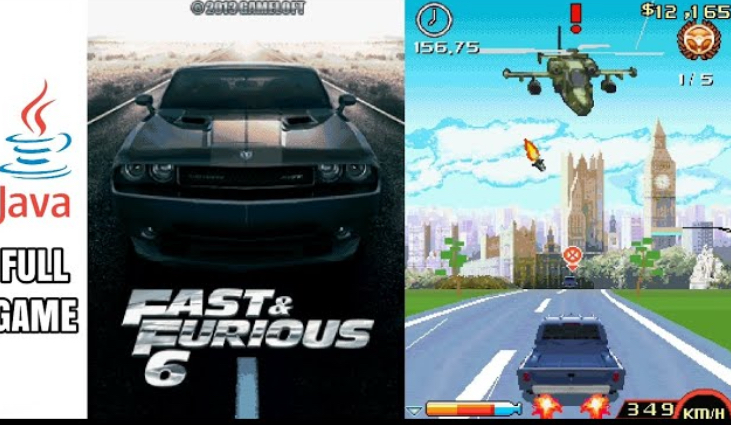

There is a certain kind of cinema that does not ask for your critical analysis or your measured intellectual response. It asks for one thing only — that you surrender completely, grip the armrest, and allow yourself to be carried away by speed, chaos, brotherhood, and the absolute conviction that the laws of physics are merely suggestions for people without enough horsepower. Fast and Furious 6 Java Game was built from exactly that same philosophy.
By 2013, the Fast and Furious franchise had long since transcended its street racing origins to become one of Hollywood’s most dominant action properties — a global phenomenon built on fast cars, impossible stunts, unbreakable family bonds, and the kind of explosive set pieces that made cinema screens feel inadequate for containing them.
And right alongside the sixth film’s thunderous theatrical release, a Java game arrived on feature phones that captured that same relentless energy with a faithfulness that genuinely surprised everyone who downloaded it. No console required. No high-end GPU necessary.
Just a feature phone, a numeric keypad, and the open road stretching endlessly ahead — because in the world of Fast and Furious, the road always stretches ahead, and the only direction that has ever mattered is forward. Full throttle. No looking back.
What Is Fast and Furious 6 Java Game?
Fast and Furious 6 Java Game is an action racing title developed for Java-enabled feature phones, released in 2013 as a mobile companion to Universal Pictures’ Fast and Furious 6 theatrical release.
The game placed players behind the wheel of the franchise’s most iconic vehicles across a series of high-stakes racing and pursuit missions drawn directly from the film’s narrative — street races through neon-lit urban circuits, highway pursuit sequences against Interpol and rival crews, and the kind of vehicle combat encounters that defined the film’s most memorable action sequences.
Unlike conventional mobile racing titles that focused purely on lap times and circuit positions, Fast and Furious 6 Java Game blended competitive racing with mission-based objectives, vehicle combat mechanics, and a story progression structure that followed the film’s key narrative beats closely enough to feel like a genuine interactive extension of the cinematic experience.
It was loud, it was fast, it was visually striking for its platform, and it understood completely what Fast and Furious fans wanted from a mobile game bearing the franchise’s name.
Key Features
- Official Fast and Furious 6 Licensing — Full franchise authentication covering vehicles, characters, locations, and narrative elements drawn directly from the sixth film, delivering an experience that felt genuinely connected to the cinematic universe rather than a generic racing game wearing borrowed branding.
- Iconic Vehicle Roster — A carefully assembled garage of franchise-signature vehicles including Dominic Toretto’s iconic Dodge Charger, Brian O’Conner’s Nissan GT-R, the Flip Car used by the film’s antagonists, and several other vehicles central to the film’s action sequences, each with distinct performance profiles covering top speed, acceleration, handling, and durability.
- Mission-Based Story Campaign — A structured narrative campaign following the film’s key story beats across multiple mission types, connecting racing sequences, pursuit encounters, and vehicle combat scenarios into a cohesive progression arc tied directly to the Fast and Furious 6 plot.
- Street Racing Mode — High-speed competitive racing across urban circuits and highway stretches against rival crew members and law enforcement pursuers, prioritizing raw speed and aggressive line-holding over technical circuit navigation.
- Vehicle Combat System — A dedicated mechanic allowing players to ram, sideswipe, and force rival vehicles off the road during pursuit and combat missions, reflecting the franchise’s signature blend of racing competition and vehicular action combat.
- Nitrous Boost System — An authentic franchise-faithful nitrous oxide acceleration system allowing players to deploy speed bursts at critical race and pursuit moments, buildable through aggressive driving behavior including drafting, near-miss passing, and successful vehicle combat engagements.
- Pursuit & Escape Missions — Dedicated mission types placing players either as pursuers chasing down target vehicles or as escapees evading law enforcement and rival crew pursuit, requiring fundamentally different tactical approaches between offensive and defensive driving scenarios.
- Vehicle Upgrade System — A progression mechanic covering engine performance, nitrous capacity, handling stability, armor rating, and visual customization, allowing players to develop their chosen vehicle into a machine tailored to their preferred driving style across the campaign’s escalating challenge requirements.
- Multiple Urban Environments — Race and mission locations drawn from the film’s international settings including London street circuits, Spanish highway sequences, and the film’s climactic runway environment, each rendered with enough visual distinction to feel meaningfully different from one another.
- Crew Character Roster — Playable and narrative appearances from the film’s principal cast including Dominic Toretto, Brian O’Conner, Letty, Roman, Tej, and Han, connecting the game’s mission structure to the franchise’s beloved ensemble character dynamics.
- Rival AI Behavior — Aggressive artificial intelligence modeled on the film’s antagonist driving style, including deliberate ramming maneuvers, tactical blocking of overtaking lines, and coordinated multi-vehicle pursuit patterns that demanded proactive defensive and offensive responses.
- Difficulty Progression — A naturally escalating challenge curve across the campaign that introduced new mission complexity, faster rival vehicles, and more aggressive pursuit behavior as the story advanced, keeping competitive pressure consistently relevant throughout the full game experience.
- Checkpoint Racing Format — Time-pressure checkpoint structures within street racing missions requiring players to maintain competitive pace across sequential waypoints rather than simply focusing on a single finish line, adding rhythm and urgency to the racing format.
- Crash & Recovery System — A vehicle damage and recovery mechanic reflecting the franchise’s tradition of spectacular automotive punishment — significant collision damage reduced vehicle performance measurably, incentivizing cleaner driving lines while preserving the ability to continue after the inevitable contact of aggressive racing and combat sequences.
- Score & Performance Tracking — Comprehensive mission performance records covering completion time, nitrous efficiency, rival vehicles eliminated, damage sustained, and overall mission rating, providing competitive benchmarks and replay incentives for players seeking maximum performance across every campaign mission.
How to Play
Basic Controls
Fast and Furious 6 Java Game uses a clean, instinctive keypad layout designed to keep both hands mentally engaged during high-speed racing and combat sequences:
- 2 — Accelerate / Full throttle
- 8 — Brake / Reverse
- 4 — Steer Left
- 6 — Steer Right
- 5 — Nitrous Boost / Speed burst activation
- 7 — Handbrake / Drift initiation
- 0 — Ram / Vehicle combat strike against adjacent rival
- 1 — Sideswipe Left / Force rival vehicle left
- 3 — Sideswipe Right / Force rival vehicle right
- 9 — Rear view / Check pursuing vehicles
- # — Pause race / Access mission menu
- * — Toggle camera between chase cam and bumper cam
- OK button — Activate special vehicle ability where applicable
Racing & Combat Combinations
| Technique | Combination |
|---|---|
| Perfect Launch | Hold 2 at maximum rev point before countdown reaches zero for clean wheelspin-free launch |
| Nitrous Timing | 5 on corner exit when vehicle is already straightening — never through apex |
| Nitrous Build | Draft closely behind rival + near-miss oncoming traffic + 5 when meter reaches maximum |
| Combat Ram | Draw alongside rival + 0 for direct ram — most effective at matching speeds |
| Sideswipe Sequence | 1 or 3 repeatedly while alongside rival to push progressively toward barriers |
| Pursuit Evasion | Alternate 4 and 6 in irregular pattern to prevent pursuing AI from predicting line |
| Controlled Drift | 7 handbrake + 4 or 6 simultaneously to rotate vehicle through tight corner |
| Drift Recovery | Counter-steer with opposite direction key immediately after rotation to catch slide |
| Slipstream Draft | Maintain close following distance behind leading vehicle for passive speed increase |
| Slipstream Strike | Build draft speed + 5 nitrous to slingshot past + 0 immediately for contact |
| Barrier Force | Position alongside rival near barrier + sustained 1 or 3 sideswipe to eliminate |
| Emergency Brake | 8 hard braking + 4 or 6 simultaneously to rotate vehicle and change direction rapidly |
| Flip Car Counter | Maintain maximum speed with 2 + veer away with 4 or 6 when Flip Car approaches |
| Convoy Assault | Target rear vehicle in convoy first with 0 + advance forward systematically through formation |
Vehicle Strategy & Upgrade Priority
The vehicle you choose before each mission determines the tactical approach available to you throughout its duration.
Dominic Toretto’s Dodge Charger rewards pure aggression — its superior armor and ram strength make vehicle combat sequences significantly more favorable while its top speed remains competitive enough for straight racing sections.
Brian O’Conner’s Nissan GT-R prioritizes agility and acceleration over brute force, excelling in technical urban circuits where corner exit speed determines race positions more than straight-line pace. The Flip Car, available in specific combat missions, operates on entirely different tactical principles — offensive momentum and directional control replacing conventional racing line discipline entirely.
Upgrade priority should follow a consistent philosophy regardless of chosen vehicle. Nitrous capacity upgrades first — a larger nitrous reserve extends the decisive speed advantage available at critical race and combat moments across every mission type in the campaign. Engine performance second — raw top speed increase benefits every mission regardless of type or objective. Armor rating third — reduced damage from rival combat encounters and barrier contact preserves vehicle performance integrity across longer multi-stage missions where cumulative damage otherwise compounds into a significant performance deficit by the final section.
Mission Type Strategy
Street Racing Missions — Pure competitive racing against rival crew members across urban circuits and highway stretches. Secure an early lead using the perfect launch start combination and defend position aggressively through the opening sector.
Deploy nitrous at corner exits rather than straight-line midpoints to maximize the speed advantage through the following corner entry. Use sideswipe mechanics to disrupt rival vehicles challenging for your position rather than allowing clean overtaking attempts that require costly defensive responses.
Pursuit Missions — Player as pursuer, targeting specific vehicles for elimination or forced stoppage. Close distance rapidly using slipstream drafting rather than raw nitrous expenditure, preserving boost reserves for the decisive combat engagement once alongside the target.
Target vehicle tires and rear sections with sideswipe attacks for maximum destabilization rather than direct frontal ram attempts that risk your own vehicle’s directional control at high speed.
Escape Missions — Player as target, evading law enforcement and rival pursuit across extended high-speed sequences. Irregular steering patterns prevent pursuit AI from establishing predictable intercept lines.
Traffic navigation at speed creates natural barriers between your vehicle and pursuers. Nitrous deployment through populated traffic sections creates separation distance that structured pursuit formations struggle to close quickly enough to maintain contact.
Vehicle Combat Missions — Multi-objective missions requiring sequential elimination of multiple rival vehicles across a single continuous sequence.
Always target the nearest vehicle first rather than attempting to bypass closer rivals to reach priority targets — unchecked nearby rivals consistently interfere with attacks on distant targets and create dangerous crossfire situations that damage your vehicle from multiple directions simultaneously.
Tips to Win
Never neglect the nitrous build mechanic in favor of passive racing — actively seeking draft opportunities behind rival vehicles and deliberately threading through oncoming traffic gaps between nitrous deployments keeps your boost meter consistently full and your speed advantage consistently available at decisive moments.
Study each mission’s route during the first attempt rather than focusing purely on performance — understanding where corners tighten, where traffic density increases, and where rival vehicles initiate their most aggressive combat maneuvers allows the second and subsequent attempts to apply precise tactical responses rather than reactive improvisation.
In vehicle combat sequences prioritize your own vehicle’s survival above rival elimination speed — a slower methodical approach that preserves armor integrity throughout a mission consistently outperforms aggressive play that eliminates rivals quickly but arrives at mission conclusion with critically damaged vehicle performance.
Get the game | Jar
Why It Still Matters
Fast and Furious 6 Java Game arrived at the precise intersection of two cultural peaks — a film franchise operating at the absolute height of its global popularity and a Java gaming platform producing its most technically accomplished work in the final years before smartphones rendered it obsolete.
It caught both waves simultaneously and rode them with the same commitment to full-throttle forward momentum that defined everything the Fast and Furious name had ever stood for.
For fans across Africa, Southeast Asia, South Asia, and Latin America who experienced the franchise’s sixth chapter not in multiplexes but through feature phone screens, this game was the Fast and Furious 6 experience in its most immediate and personal form — no ticket price, no cinema queue, just the open road and everything the Toretto crew had always represented. Speed. Family.
The absolute refusal to finish anywhere but first. That was the film. That was this game. And decades from now, the people who played it on original Java hardware will remember both with exactly the same affection.
“It doesn’t matter if you win by an inch or a mile — winning’s winning. And on a Java phone, this game always found a way to win.”
—————————————————————————
This content is published for review and educational purposes only.
All trademarks, game titles, and related assets belong to their respective owners. We do not host any download files and the links are for respective users.
