


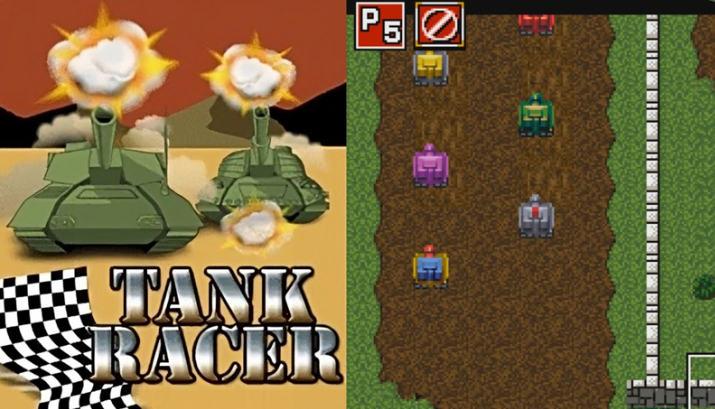

Not every legend arrives wrapped in a superhero suit or armed with a hidden blade. Some legends arrive on four wheels, engine screaming, tires barely gripping the asphalt, with nothing between you and the finish line except raw speed, sharp reflexes, and the burning refusal to finish anywhere but first.
Tanker Racing 3D Java Game was exactly that kind of legend — loud, fast, unapologetic, and absolutely impossible to put down once the first race began.
In an era when mobile racing games were either too shallow to hold attention or too technically demanding for modest Java hardware, Tanker Racing 3D arrived and split the difference with remarkable precision.
It looked better than it had any right to look. It played better than its file size suggested it should. And it delivered the core fantasy of high-speed racing — the rush, the competition, the perfectly timed overtake on a hairpin corner — with a clarity and confidence that left every rival mobile racing title of its era trailing far behind in the rearview mirror.
For an entire generation of speed lovers who could not afford a console or a gaming PC but owned a Java phone and a hunger for competition, this was their racing circuit. Their podium. Their chequered flag.
What Is Tanker Racing 3D Java Game?
Tanker Racing 3D Java Game is a three-dimensional racing title developed for Java-enabled feature phones, designed to deliver a genuine high-speed racing experience within the constraints of modest mobile hardware.
The game placed players behind the wheel of powerful racing vehicles across a series of tracks that ranged from smooth urban circuits to challenging countryside roads and technically demanding mountain passes.
The three-dimensional presentation was the game’s most immediate distinction from its contemporaries — rather than the flat, top-down or side-scrolling perspective that dominated Java racing titles of the period, Tanker Racing 3D rendered its environments from a genuine behind-the-car perspective that created a compelling sense of speed, depth, and spatial immersion previously rare on Java hardware.
Multiple race modes, a vehicle roster with distinct performance characteristics, and a progression system that rewarded consistent podium finishes with access to faster cars and more demanding circuits combined to create a racing experience with genuine longevity and replay value well beyond a casual afternoon’s entertainment.
Key Features
Tanker Racing 3D Java Game packed a surprisingly comprehensive racing package into its modest file size.
The vehicle roster offered a selection of cars spanning different performance tiers — entry-level vehicles suited to learning the game’s physics and track layouts, mid-tier machines that balanced speed with handling stability, and top-tier racing cars that demanded precise control in exchange for blistering straight-line pace.
Track environments varied meaningfully across the circuit roster, covering city streets lined with barriers and tight chicanes, open highway sections rewarding pure speed management, rural roads with unpredictable surface changes, and technical mountain circuits where braking points and corner entry angles determined race outcomes more than engine power alone.
A championship mode structured races into seasonal tournaments with standings, points, and title implications across multiple race weekends. Weather and time-of-day variations affected track conditions on select circuits, adding an environmental strategy layer to vehicle and setup choices before each race.
The game’s physics model, while appropriately arcade in nature for its platform, delivered enough authentic handling feedback to make vehicle control feel meaningful and skill-dependent rather than arbitrary.
How to Play
Basic Controls
Tanker Racing 3D Java Game uses a clean, responsive keypad layout that prioritizes instinctive control during high-speed racing situations:
- 2 — Accelerate / Full throttle
- 8 — Brake / Reverse
- 4 — Steer Left
- 6 — Steer Right
- 5 — Nitro boost / Speed burst activation
- 7 — Handbrake / Drift initiation
- 1 — Gear Down / Downshift (manual transmission mode)
- 3 — Gear Up / Upshift (manual transmission mode)
- 9 — Rear view mirror / Check position of following competitors
- 0 — Horn / Signal (cosmetic function on select versions)
- # — Pause race / Access race menu
- * — Toggle camera view between bumper cam and chase cam
- OK button — Confirm selections in menus / Restart race
Racing Combinations & Advanced Techniques
| Technique | Combination |
|---|---|
| Perfect Launch Start | Hold 2 at maximum rev point just before countdown reaches zero for clean launch |
| Controlled Drift | 7 handbrake + 4 or 6 simultaneously to initiate corner drift |
| Drift Recovery | Counter-steer with opposite direction key immediately after drift initiation to catch slide |
| Nitro Timing | 5 on corner exit when car is already straightened — never mid-corner |
| Late Braking | Maintain 2 acceleration deep into corner approach + 8 at last possible moment |
| Apex Clipping | 4 or 6 to position car to inside of corner at apex point for shortest racing line |
| Slipstream Draft | Maintain close following distance behind leading car — speed increases passively |
| Slipstream Overtake | Build slipstream speed behind leader + 5 nitro boost to slingshot past on straight |
| Chicane Carry | Minimal braking through tight chicane sections — use 4 and 6 alternately in rapid succession |
| Hairpin Setup | Brake early with 8 + position wide with 6 + apex tight with 4 + accelerate with 2 on exit |
| Bump Draft | Nudge leading competitor with gentle 2 acceleration contact on straights to destabilize their line |
| Defensive Block | Mirror competitor’s steering inputs with 4 or 6 to close overtaking space on approach to corners |
Vehicle Performance Guide
Understanding your vehicle’s performance characteristics before each race determines strategy from the very first corner:
Entry Level Vehicles — Lower top speed and modest acceleration but forgiving handling that tolerates driver errors without severe consequence. Ideal for learning circuit layouts, perfecting braking points, and developing the muscle memory for consistent corner entry and exit techniques. Do not dismiss these vehicles as irrelevant once faster options unlock — returning to them occasionally sharpens fundamental skills that transfer directly to higher-performance machinery.
Mid Tier Vehicles — The sweet spot of the game’s vehicle roster. Sufficient straight-line speed to compete at the front of any grid while retaining enough handling stability to recover from minor errors without losing race position catastrophically. Championship runs are most consistently won from this tier because the performance ceiling is high enough to challenge and the forgiveness margin is wide enough to survive inevitable mistakes.
Top Tier Racing Cars — Maximum performance in every measurable category but zero tolerance for imprecision. A late braking error that costs half a second in a mid-tier car costs two seconds and a position in a top-tier machine. Mastery of the racing line, braking points, and nitro deployment timing is non-negotiable before these vehicles reward the driver rather than punish them.
Track Strategy by Circuit Type
City Street Circuits — Tight barriers, frequent direction changes, and limited overtaking opportunities define urban racing. Qualify well on these tracks because grid position matters more here than anywhere else — passing opportunities are rare and defensive driving from a leading position is far easier than aggressive overtaking from behind. Brake early, hit every apex cleanly, and prioritize consistency over heroics.
Highway Sections — Pure speed management territory. Gear shifts, nitro deployment timing, and slipstream utilization determine outcomes on open road sections. Draft behind the leader for two straights, build speed advantage, and deploy nitro on the third straight for a clean decisive overtake that carries through the following corner sequence.
Mountain Pass Circuits — The most technically demanding tracks in the game. Elevation changes affect braking distances, blind crests demand positional memory rather than reactive driving, and the narrow road width punishes wide lines severely. Learn these circuits in time trial mode before entering championship races — arriving at a mountain pass without prior knowledge of its layout is a reliable route to last place regardless of vehicle quality.
Mixed Layout Circuits — These tracks combine elements of all three circuit types within a single lap and demand the most complete racing skillset. No single tactical approach dominates — adaptability between aggressive highway racing, precise city street navigation, and cautious mountain technique within the same lap is the defining skill separating front runners from midfield competitors.
Championship Mode Strategy
Consistency beats outright speed in championship mode.
A driver who finishes second in every race accumulates points far more reliably than one alternating between victories and retirements. Protect your car from heavy contact in opening lap situations where adrenaline and competitive instinct encourage unnecessary risk-taking — a damaged vehicle in the first corner of race one can compromise an entire championship weekend. Target podium finishes rather than victories in the early championship rounds while learning circuit layouts, then push for race wins once track familiarity allows genuine challenge for leading positions.
Manage nitro reserves across each race rather than deploying everything in the opening lap — a full nitro charge available in the final sector of the final lap of a close race is worth more than three early-race boost deployments that only extend a comfortable lead unnecessarily.
Why It Still Matters
Tanker Racing 3D Java Game occupies a genuinely special place in the history of mobile racing — not because it revolutionized the genre or broke technological barriers that no other title had approached, but because it delivered exactly what every racing fan who picked it up was looking for with absolute reliability and complete commitment.
It never oversold itself. It never pretended to be something beyond its hardware’s capability. It simply put you behind the wheel, gave you a track, populated the grid with competitive opponents, and let the racing do everything the marketing ever needed to say.
In regions across Africa, South Asia, and Southeast Asia where feature phones remained the primary personal computing device long after smartphones had transformed wealthier markets, Tanker Racing 3D was the racing simulator — the title against which every other mobile racing experience was measured and, more often than not, found lacking.
Today it survives in emulator libraries and nostalgic gaming communities whose members speak about its corner physics and championship tension with the same affection reserved for console classics that cost fifty times as much and required hardware one hundred times as powerful.
That is not nostalgia distorting memory. That is simply an honest assessment of a game that was, within its world and on its terms, completely brilliant.
“No pit lane. No paddock. No team radio. Just you, the road, and everything you had — pressed flat to the floor, corner after corner, until the chequered flag said otherwise.”
—————————————————————————
This content is published for review and educational purposes only.
All trademarks, game titles, and related assets belong to their respective owners. We do not host any download files and the links are for respective users.
